“How does Ithaca Waldorf School handle conflict?”
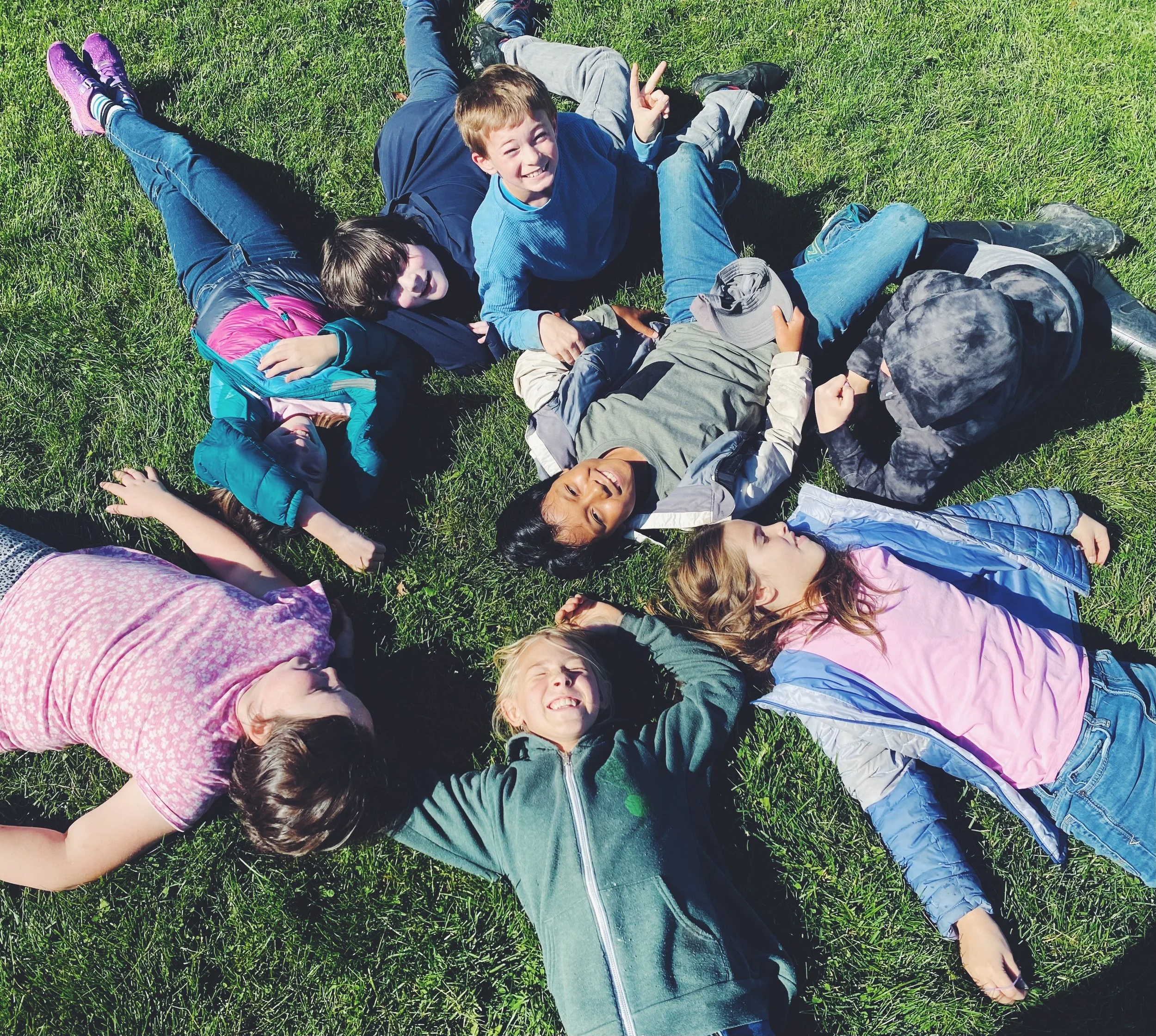
The happy result of community building in our 4th and 5th grade classroom.
As parents and educators, we know that developing qualities like confidence, self-control, and resilience can have a profoundly positive effect on student achievement. We know that empathy, creative thinking, and the ability to effectively communicate may soon be among the most sought-after skills in the job market. And we know that meaningful relationships are the foundation for a meaningful life.
Can qualities like kindness and compassion be taught? Does social-emotional skill-building belong in the classroom? Yes. At Ithaca Waldorf School, we place tremendous value on human relationships and community building. “We teach our students that they're not just kids, they are human beings. Their needs and thoughts and ideas are important,” says Miss Katherine, 3rd grade class teacher. “We also teach them how to work with others and have genuine care and compassion for other people's ideas.”
How do we do it? We spoke with Miss Katherine about how Ithaca Waldorf School’s strong social community and compassionate approach to conflict resolution fosters maturity, resilience, and self-confidence in our students.
Teacher-Student Relationships Built on Trust
In Waldorf education, it is common for the lead teacher to remain, or “loop,” with the same cohort of students through multiple grade levels. Miss Katherine, for example, has been teaching the third grade class since they were first graders. This model creates “a foundation of trust, which is very beneficial,” says Miss Katherine. “Kids know that as they grow and change, the teacher is growing and changing with them.”
By getting to know their students over multiple years, teachers have deeper insight into each child and how to best encourage their holistic development—as well as how to support them through challenges, both academic and social. “My students are only in third grade. As school gets more challenging and the academics get harder, they know that I'm there to support them and have their back.”
Teachers also serve as important role models and mentors, teaching them human qualities like patience, respect, and kindness. “When they're young children, they really need to be guided,” explains Miss Katherine.
Close-Knit Class Cohorts
At Ithaca Waldorf School, group work, games, movement, stories, and ensemble activities, alongside time for unstructured socializing and play, encourage students to work together and get to know all their classmates intimately. This creates a foundation of trust in the classroom, where every student is seen for who they are. Miss Katherine explains, “We have this core group of people that are standing by our side no matter what. You don’t have to prove who you are. We’ve all seen each other try and fail at something, or try and succeed.”
Importantly, these values aren’t just implicit; they are explicitly taught. In Miss Katherine’s classroom, for example, students create shared agreements, establishing class rules based on “mutual respect and of kindness” at the beginning of each school year. “We talk about what you are excited about in the year ahead, and what you are hoping to do by year’s end,” Miss Katherine says. “Say a student gets distracted in handwork class, but really, really wants to finish knitting their hat this year. We ask, ‘what could we do in handwork to make sure that we're all helping that student have their goal met?’ For example, not interrupting when the teacher is giving instructions.”
“Year to year, you're establishing the guidelines for the classrooms and for their behavior and their self-regulation,” she continues. “I'm going to respect my teachers. I'm going to respect my classmates. I'm going to respect the materials in school.”
Restorative Practices
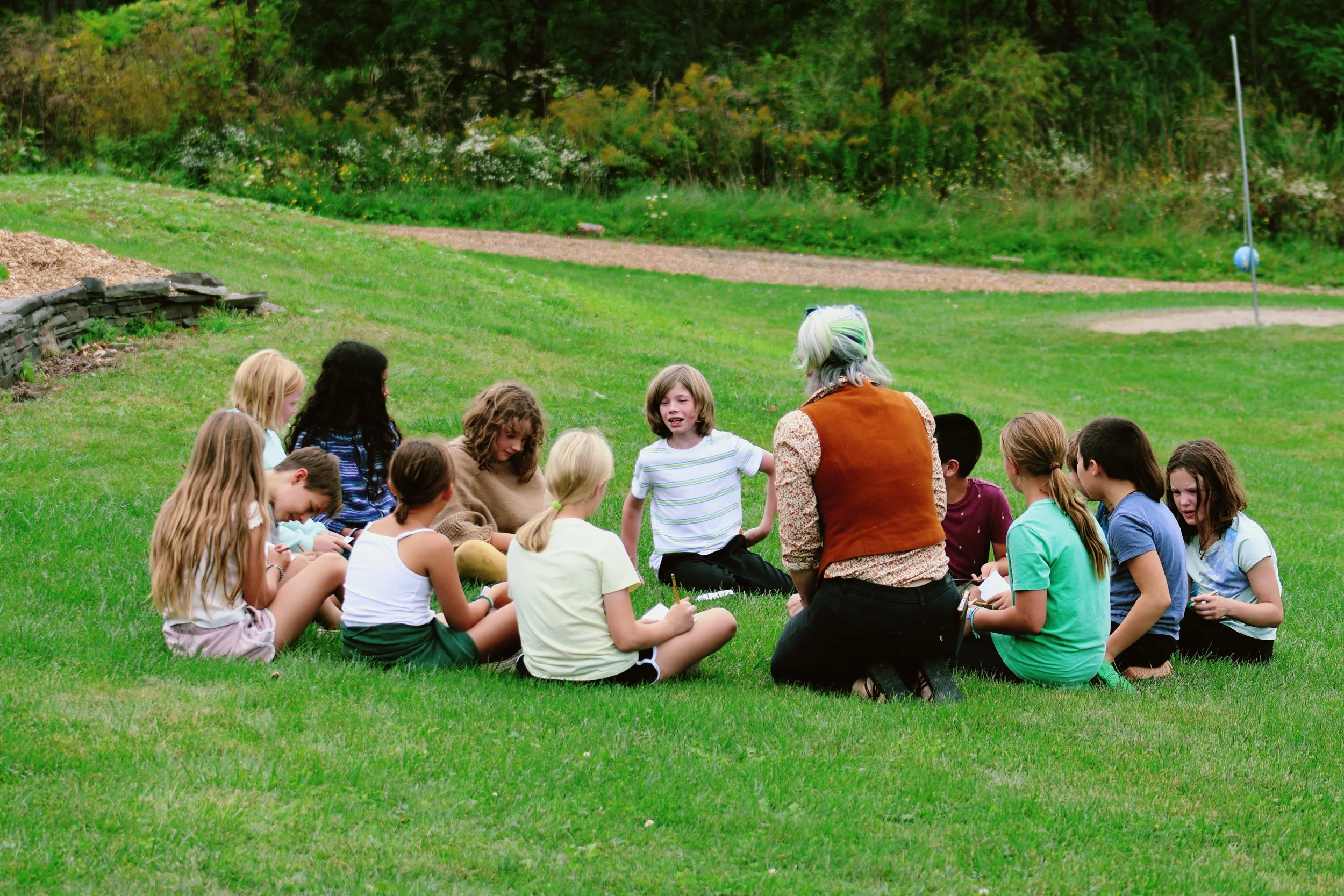
A community circle among middle school students as part of our Festival of Courage.
The ability to actively listen, to respect others, and to resolve conflicts with compassion are teachable skills, which can be nurtured in children with clear and direct guidance from adults. Conflict, when it arises, is an opportunity to build valuable social-emotional skills.
At Ithaca Waldorf School, we use Restorative Practices (an evolution of Restorative Justice Practices) to address conflicts both big and small. This method begins with practicing sharing and listening in a circle in times of peace. Each morning, Miss Katherine brings an open-ended question or two to her students, and they listen closely while each child takes a turn holding the talking piece and sharing their answer. These community circles build the trust and listening skills needed for addressing acute conflict when it arises.
When trouble arises between two students or in groups, we use “micro circles,” which build compassion and communication skills by encouraging students to listen carefully to each other and work collaboratively to find solutions.
“I typically ask the child who's the most upset what's going on first,” explains Miss Katherine. “That child has an opportunity to say what they need the other person to know. The other person is quiet. It is their moment to fully listen. No interrupting. No defending. And then when they have said everything they need to say, it's the next person's turn to do the same thing.”
Giving everyone an opportunity to be heard is one of the ways we build respect and compassion between students, while also empowering students with confidence in their own experience and feelings. “The goal is each child is learning how to listen, but also learning how to stand up for themselves and advocate for themselves,” explains Miss Katherine. “We really see the children as full human beings, who are growing.”
Student-Driven Solutions
What makes our approach to conflict resolution particularly powerful is that “the solutions are figured out by the children,” who are guided by their teacher to propose meaningful solutions, not quick gratification or easy answers. While modern parenting has swung more toward gentle and easy solutions to problems, we take the time to develop real human resolutions to conflicts, even when they require patience and time.
“Sometimes it takes one conversation to fix it, but sometimes it doesn't,” says Miss Katherine. “Sometimes it really takes trying it out, and then you have to come back again. We are teaching kids that things take time, but as long as you have people who are willing to listen and agree to work through it, then all is well and it will be okay in the long run.”
As students grow older and become more familiar with the Restorative Practices model, they are given the opportunity to practice it for themselves. “The process is always facilitated by an adult, and it’s a much more active role when the children are really young,” Miss Katherine explains. “Ideally by middle school they're entirely facilitating it.” In fact, it’s common that “a student will be the one leading the circle to help two others through their conflict. “These are kids who have just been practicing it throughout the years with each other,” she continues. “They have this trusted ground.”
“Don’t Be a Crow”
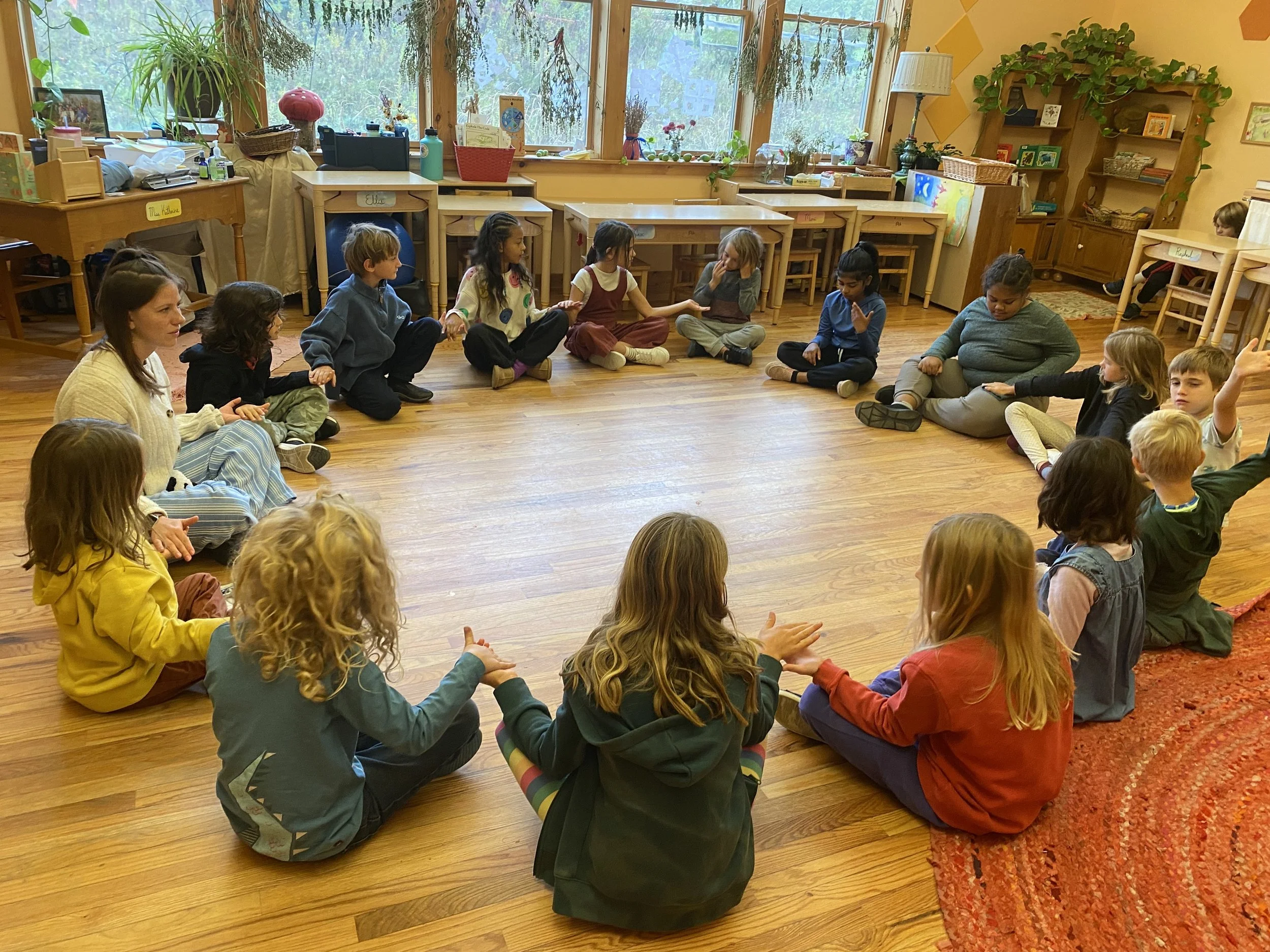
Third graders start their day with open-ended questions and and listening practices.
In addition to Restorative Practices, “another crucial piece in Waldorf education is pedagogical stories,” says Miss Katherin, who explains that stories give teachers an opportunity to present moral and social lessons in a way that is personally meaningful to their students.
For example, Miss Katherine recently addressed the feelings of a student being left out at recess by telling a story about a group of crows and a solitary hawk who initially clashed over their shared territory. At the story’s climax, the children uncover how the fun-but-self-centered crows have unfairly judged and excluded the hawk—which led to the classroom catchphrase, “Don’t be a crow.”
Importantly, the stories are “not always explicit and obvious,” says Miss Katherine, who notes that children must use critical thinking and problem-solving skills to decipher and internalize the deeper message. “These stories are clear enough that students connect with the point, and recognize their own behavior and adjust it. But they are open-ended enough that children don't feel like you're telling them to behave a certain way. They're actually making those connections on their own.”
When More Help Is Needed
When Miss Katherine notices a prolonged conflict between students, or a conflict that involves multiple students targeting another, “it needs to be addressed with the class so that it does not become more harmful.” This might begin with a pedagogical story to inspire more empathy and discussion between students. In addition, “I watch their recess play and interject if something feels not right,” Miss Katherine says.
While the faculty aims to proactively approach conflicts as teachable moments, we never minimize serious issues when they arise. We do not allow any form of bullying, repeated and targeted harm directed at particular individuals—distinct from conflict that arises more spontaneously from the natural challenges of working with others and learning social skills. “If there's something serious, it is addressed right away,” says Miss Katherine, noting that causing direct harm has consequences that are determined by adults, not through collaborative conflict resolution. “In any case of bullying or direct harm, which we don’t see often, the school would take it into our hands.”
“In restorative practice, that's tier two,” Miss Katherine continues. “It isn’t a child’s job to create the consequences for a person causing harm. The school would have to be involved.” That said, “The child who had done something wrong will still get an opportunity to explain what happened or apologize. What do they need to earn that respect and trust back, but in a new, positive way?”
For children engaged in a conflict that isn’t easily resolved—or who need extra support in building social-emotional skills—our SEL specialist is available to step in. She also trains all of our teachers to identify where, on a spectrum, an incident of conflict falls: times when the children can solve problems by themselves under adults’ observation, times when a teacher’s guidance is needed, and times when immediate intervention by an adult is the only means for safety and well being. Our SEL team is available to supervise children who need a break, need time outside, or need to talk to someone before they are ready to rejoin the group or classroom.
Among other resources, our SEL specialist offers special “lunch bunch” sessions in which children participate in role-playing and hypothetical scenarios to help them practice active listening, compassion, and communication skills. “There is also a Dungeons and Dragons group designed to help students with ‘those little tiny social nuances.’" Invitations to the lunch bunch and D&D groups are not based on participants “doing anything wrong or harming anyone,” says Miss Katherine, but the group helps students practice social cues through engaging role-playing games with friends.
Not Just for Kids
At the full faculty’s request, Ithaca Waldorf School received grants through NYSED beginning in 2025 for training and implementation support for Restorative Practices as our school’s disciplinary system. We chose this practice because of its roots in the indigenous history of our area (Haudenosaunee), because of its alignment with Waldorf’s understanding of human development (see “The Art of Geothean Conversation” by Marjorie Spock), and because of the widespread interest and opportunities offered across our school district.
This method for conflict resolution is not just for the students! In fact, before implementing it with students, the faculty learned to do community circles and micro circles with each other. As our training and implementation continues to progress, our hope is that parents and caregivers will learn to engage with our school using these tools… and maybe perhaps with each other and with children as well.
Inspiring Future Change Makers
Why do we devote so much time and effort to communication and conflict resolution at Ithaca Waldorf School? Ultimately, it’s because we aim to create future change makers, who will influence the world in positive ways. “Change is made by people who are backed and supported by a community that you care about and who care about you mutually,” says Miss Katherine.
“We hope that whatever our students decide to do in the future, whether it's a big change in the world or something really small but really meaningful, they are using it to share with others and to connect and create community wherever they go.”